Americans Have Built and Lost the Same Public Space Five Times in 400 Years
Every few months, someone writes a nostalgic piece about how Facebook used to feel like a genuine community before the algorithm took over. Or how shopping malls were once vibrant social hubs before Amazon killed them. Or how downtown squares used to be places where neighbors actually met before suburbanization destroyed them.
These aren't separate tragedies. They're the same story, told five times in American history. We build a public space, it flourishes as a genuine commons, commercial interests optimize it for profit, and then we abandon it while building the next version. The cycle takes about 80 years, and we're remarkably consistent about forgetting the previous iterations.
The Colonial Commons: Open Space, Then Enclosed
America's first public spaces were literal commons — shared grazing land in the center of colonial towns. These areas served multiple functions: livestock pasture, militia training ground, public market, and informal meeting place. Everyone had access, decisions were made collectively, and commercial activity was limited to specific days and times.
The commons worked for about a century. Then, as towns grew and land values rose, local authorities began selling off pieces to private developers. By the 1760s, most colonial commons had been enclosed, subdivided, or converted to more "productive" uses. The remaining public space was formal and regulated — town squares with restrictive rules about acceptable behavior.
Colonists complained that they'd lost the heart of their communities. They were right. But instead of fighting to preserve the commons model, they moved west and built new towns with new commons, which eventually got enclosed in exactly the same way.
The Main Street Era: Commerce and Community
By the 1840s, America's growing cities had developed a new kind of public space: the commercial main street. Unlike the regulated town square, main streets mixed business and social activity organically. People shopped, worked, gossiped, and conducted civic business all in the same space.
Main streets succeeded because they balanced public and private interests. Store owners provided the infrastructure and foot traffic, while customers and residents created the social energy. Neither group could dominate completely without killing the space.
This balance lasted until the 1920s, when chain stores and automobile infrastructure began optimizing main streets purely for commercial efficiency. Parking replaced gathering spaces, national retailers displaced local businesses, and social interaction became secondary to sales volume. By 1950, most main streets had become either tourist attractions or economic dead zones.
The Mall: Privatized Public Space
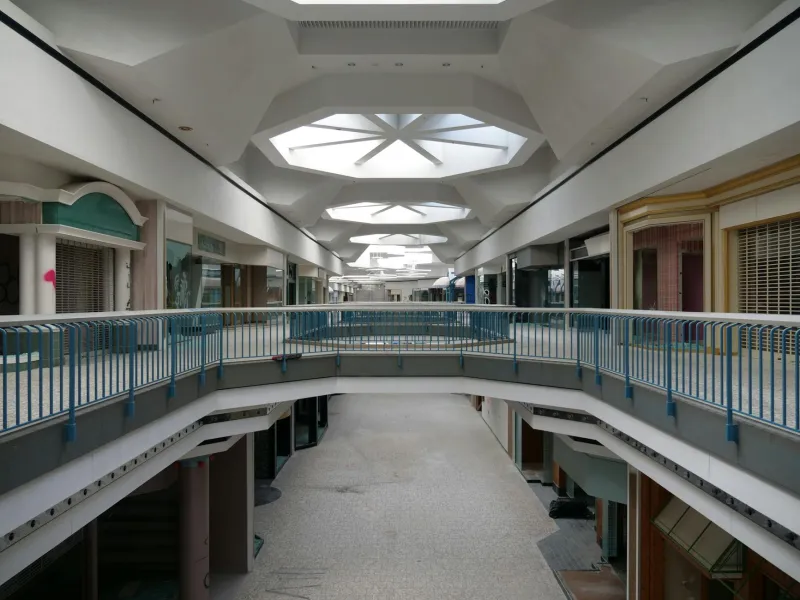
Shopping malls, which peaked between 1960 and 1990, represented America's third attempt at creating shared public space. Early mall designers explicitly tried to recreate main street energy in a controlled environment. They included community bulletin boards, public seating, and spaces for civic events.
For about 30 years, malls actually worked as public spaces. Teenagers socialized there, elderly people exercised there, families spent entire weekends there. The key was that mall owners tolerated — even encouraged — non-commercial activity because it drew customers.
But as retail competition intensified in the 1980s, mall management began optimizing for sales per square foot. Loitering policies tightened, community events were restricted, and spaces were redesigned to funnel people toward stores. Malls became efficient retail machines but lost their function as public squares.
The Internet: Digital Commons to Walled Gardens
The early internet, roughly 1985 to 2005, functioned like a digital commons. Access was relatively open, content was created by users rather than corporations, and commercial activity was limited. Forums, newsgroups, and early social networks prioritized community building over profit extraction.
This changed when venture capital discovered that online attention could be monetized at scale. Platforms began optimizing for engagement rather than genuine social connection, which meant amplifying conflict and addiction over healthy community norms. The commons became a series of walled gardens owned by corporations.
We're now watching the same complaints that accompanied every previous transition: the space has become too commercial, authentic community is disappearing, and profit motives are destroying what made the platform valuable in the first place.
The Pattern: Open, Commercial, Enclosed, Abandoned
Each cycle follows the same four-stage progression:
Stage 1: Open Access — The space is genuinely public, with minimal restrictions and shared governance.
Stage 2: Commercial Integration — Business activity gets incorporated but doesn't dominate. This is usually the golden age that people later remember nostalgically.
Stage 3: Optimization — Commercial interests take control and redesign the space for maximum profit extraction.
Stage 4: Abandonment — Users flee to newer alternatives, leaving behind empty infrastructure and nostalgic memories.
The entire cycle typically takes 60-80 years, which explains why each generation experiences the loss of "their" public space without recognizing the broader pattern.
Why We Keep Forgetting
Americans consistently fail to learn from previous cycles because we frame each transition as a unique crisis rather than a predictable pattern. We blame specific villains — greedy developers, corporate chains, tech algorithms — instead of recognizing the structural forces that make enclosure almost inevitable.
The real problem isn't individual bad actors. It's that we've never developed institutional mechanisms to protect public space from commercial capture. We build commons, assume they'll stay common, and act surprised when economic incentives push them toward private control.
What Comes Next
If the pattern holds, we're currently in Stage 4 of the internet cycle and Stage 1 of whatever comes next. The early signals are already visible: decentralized social networks, local community apps, and hybrid digital-physical spaces that combine online coordination with in-person interaction.
History suggests that the next iteration will initially seem more democratic and community-focused than what it replaces. It will probably succeed for 20-30 years before commercial optimization takes over. And the generation that grows up in that space will eventually write nostalgic articles about how authentic it used to feel.
Unless, this time, we actually learn from the previous four cycles and build protection against enclosure into the system from the beginning. The technology exists. The question is whether we have the collective memory to use it.