How Fake News Destroyed the Roman Republic
How Fake News Destroyed the Roman Republic
Somewhere around 50 BC, a Roman citizen woke up, heard that Julius Caesar had massacred his own troops in Gaul, panicked, told his neighbor, and by sundown half of Rome believed the Republic's most powerful general was finished. The story was false. Caesar had planted it himself — to gauge his enemies' reactions.
Welcome to the Roman information ecosystem. It was a mess, and it offers one of the most detailed case studies we have of what happens when a sophisticated society loses its grip on shared reality.
The Infrastructure of Lies
Here's something worth sitting with: the Romans had no printing press, no telegraph, no algorithm. And yet disinformation spread through their society with a speed and virulence that would impress a modern PR firm.
The mechanism was fama — a Latin word that translates roughly as "rumor" but carried real cultural weight. Romans personified Fama as a goddess, which tells you something about how seriously they took the phenomenon. She was depicted with a thousand mouths, each one passing along a slightly different version of the same story. Virgil described her as growing stronger with every retelling. That's not mythology. That's a psychologically accurate description of how unverified information propagates through a social network.
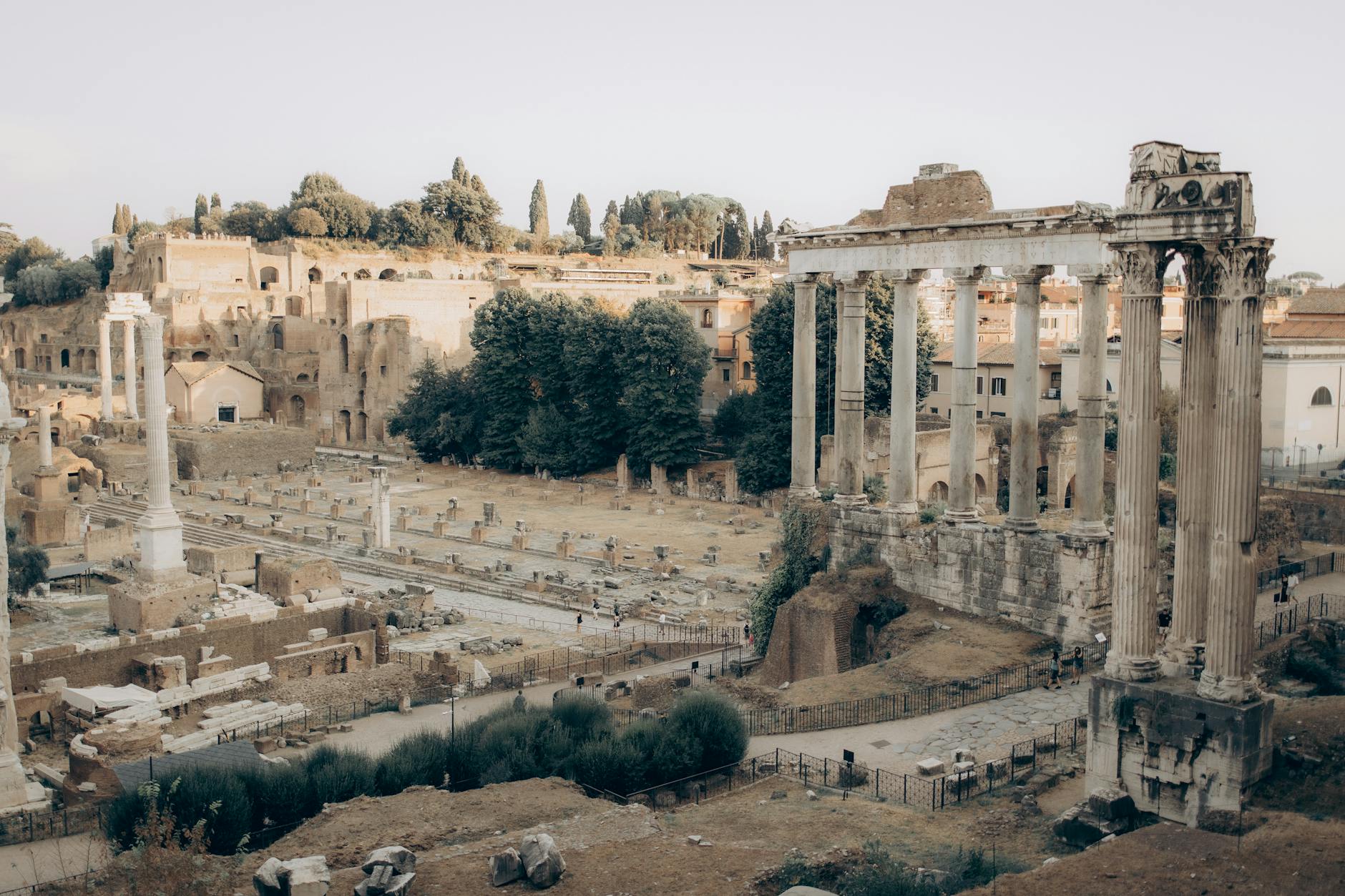
The physical infrastructure was the Forum, the bathhouses, the street corners, and the tabernae — the bars and shops that lined Roman streets. Information moved through these spaces the way it moves through group chats today: fast, context-free, and emotionally amplified. A rumor that entered the Forum in the morning could reach the outer neighborhoods by afternoon in a version that bore only a passing resemblance to its origin.
Politicians understood this. They exploited it deliberately.
Omens as Operational Tools
One of the Republic's most reliable disinformation vectors was the religious omen. Roman civic life was saturated with augury — the official reading of signs from the gods. Before any major public action, magistrates consulted augurs, who interpreted the flight of birds, the behavior of sacred chickens, or unusual natural events.
This system was ripe for manipulation, and everyone knew it. Cicero — himself an augur — wrote privately that the whole business was largely nonsense, while publicly defending it as essential to Roman order. When a political faction needed to delay a vote, block a military deployment, or discredit a rival, a conveniently timed "bad omen" was a remarkably effective tool. The chickens wouldn't eat. Lightning struck from the wrong direction. A statue sweated blood.
Were these fabricated? Sometimes obviously. But here's the psychological hook that made it work: Roman citizens wanted to believe the gods were communicating. The desire for supernatural signal in a chaotic world is not a Roman quirk. It's a human one. Research on motivated reasoning consistently shows that people evaluate evidence based on whether they want the conclusion to be true. The Romans weren't uniquely gullible. They were human.
The Forged Letter Problem
Beyond omens, the late Republic developed a robust market in forged documents. Letters purportedly from generals, senators, or foreign kings circulated through Rome, shifting public opinion on wars, elections, and criminal trials. Verifying authenticity was nearly impossible — there was no central archive, no standardized seal protocol that couldn't be copied, and no mechanism for rapid fact-checking.
The trial of Publius Clodius Pulcher in 61 BC turned partly on questions of documentary authenticity that the Roman legal system simply couldn't resolve. During the civil wars, forged correspondence was used to implicate political enemies in treasonous plots. Cicero himself was accused of fabricating documents during the Catilinarian conspiracy — a charge that haunted him for years.
The deeper problem wasn't any individual forgery. It was that once citizens understood that documents could be forged, they had no reliable method for distinguishing real ones. Trust in written evidence collapsed. And when trust in evidence collapses, the loudest and most confident voice tends to win.
What the Psychology Actually Shows
Modern research on misinformation gives us a useful framework for understanding what was happening in Rome. Studies — yes, including the ones run on college students — consistently show a few things: corrections rarely fully undo the damage of false information (the "continued influence effect"); people sharing false information usually aren't lying, they genuinely believe it; and social proof matters enormously, meaning that if everyone around you believes something, your threshold for skepticism drops.
All three of these dynamics were present in Rome. The corrections never caught up to the rumors. The people spreading bad omens often believed in them. And in a society where everyone around you was treating augury as real, skepticism was socially costly.
The Republic's institutions — the Senate, the courts, the priesthoods — were theoretically designed to filter signal from noise. But those institutions were staffed by the same psychologically normal humans who were susceptible to the same biases. When the institutions themselves became players in the disinformation game, there was no higher authority to appeal to.
The Shelf Life of a Broken Information Environment
The Republic survived its information crisis for a while. Romans are often credited with remarkable institutional resilience, and that's fair — the system limped along for decades after it was clearly compromised. But the accumulated weight of manufactured crises, forged justifications for violence, and populations that had lost confidence in any shared factual baseline made the transition to autocracy not just possible but, for many Romans, welcome.
Augustus, Rome's first emperor, understood the information environment better than anyone before him. He didn't try to restore epistemic order. He monopolized the production of official narrative instead — controlling the poets, the historians, the public monuments, and the religious calendar. He didn't fix the broken information ecosystem. He became it.
The lesson the Roman record offers isn't that misinformation inevitably destroys institutions. It's more specific than that: institutions that can't develop credible mechanisms for establishing shared truth tend to be replaced by ones that simply impose it. The population, exhausted by not knowing what to believe, often accepts that trade.
Five thousand years of data. The pattern keeps showing up. The technology changes. The psychology doesn't.